
Carnarvon Gorge Guide: Walks, Camping and Tips From Locals (Updated for 2027)
By Caity and Christian, Azure Nature Tours. Updated October 2026.
We live on Nyanda, a cattle station at the gateway to Carnarvon Gorge, and we’ve guided people through this country for years. Most guides to the Gorge are written by people who visited once. This one is written by people who live here, drive these roads every week, and still find something new every time we walk in.
Below is everything we’d tell a friend before they came out. It covers getting here, the walks, where to stay, the best time to visit, and the mistakes we see people make.

Carnarvon Gorge at a glance
Where: Central Queensland’s Sandstone Wilderness, roughly halfway between Roma and Emerald. Brisbane is about 720km away, a solid nine hours of driving.
Road in: sealed all the way to the park entrance. No 4WD needed.
Entry fee: none. You only pay if you’re camping in the national park.
Main walk: the main gorge track runs 9.7km one way from the visitor area to Big Bend, with side tracks to the famous sites along the way.
Best time to visit: April to September for the most comfortable walking weather.
How long to stay: two full days at the very least. Three or four is better.
Fuel: none after Rolleston (north) or Injune (south).
Phone coverage: limited and unreliable. Free Wi-Fi at the visitor centre from 8am to 4pm.
Dogs: not allowed in the national park. There are dog-friendly options nearby, covered below.
What makes Carnarvon Gorge so special
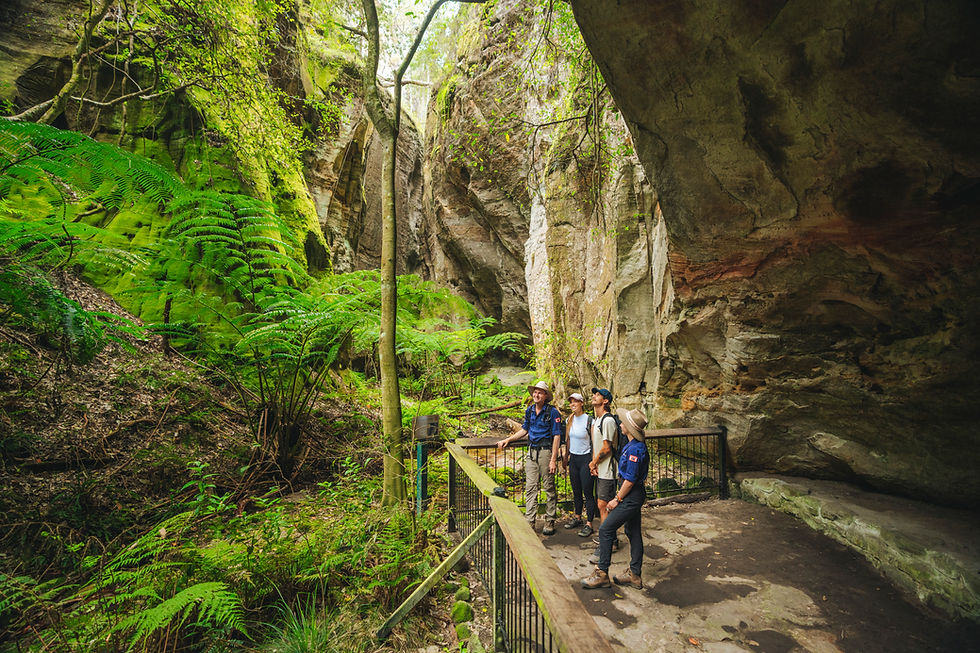
Carnarvon Gorge is an oasis in dry country. For hundreds of kilometres around, the landscape is brigalow, grassland and open woodland. Then you walk into the Gorge, and it’s suddenly cool and green. There are palm-lined creeks, mossy walls dripping with water, and pockets of rainforest that shouldn’t really exist this far inland.
The secret is water. Rain falling on the high country soaks slowly down through the sandstone until it hits a layer of shale it can’t pass through. It then moves sideways and seeps out of the Gorge walls as springs. That’s why Carnarvon Creek keeps flowing even after months without rain. It’s also why plants left over from a much cooler, wetter Australia have survived here.
The geology, told properly
The towering white cliffs of Carnarvon Gorge are Precipice Sandstone, laid down by rivers in the early Jurassic period. You’ll sometimes read that the Gorge walls are Clematis Sandstone, but that’s not right. The older Triassic Clematis Sandstone forms the Carnarvon Range and the Mount Carnarvon cliffs nearby.
Carnarvon Creek has carved through these layers over millions of years, and the rocks of the wider region tell a much longer story. Under the ranges here are rocks that record over 290 million years of Earth’s history. If that grabs you, our Deep History page tells the whole story.
A place with deep cultural roots
The Bidjara and Karingbal peoples are the Traditional Owners of this country, and their connection to it goes back many thousands of years. Today’s Traditional Custodians often describe the Gorge as a place of learning, with that connection extending across the whole landscape, not just the rock art sites. The stencil art in the Gorge is regarded as some of the finest in Australia (more on that below).
The first section of the Gorge was declared a national park in 1932. Today the whole Carnarvon National Park covers around 298,000 hectares, with Carnarvon Gorge the best-known and most visited section.
How to get to Carnarvon Gorge
There are two main approaches, and both are fully sealed through to the park.
From the south (Brisbane, Toowoomba, Roma): drive north from Roma to Injune, then continue up the Carnarvon Highway to the signed Carnarvon Gorge turn-off.
From the north (Emerald, Rockhampton): drive south from Emerald to Springsure, east to Rolleston, then south on the Carnarvon Highway to the turn-off.
From the turn-off, it’s 45km of sealed road to the park entrance, then another 5.9km to the visitor area. The road is fine for conventional cars and caravans.
Fuel up before you leave town. Rolleston (about 106km north of the park) and Injune (about 111km south) are your last stops for fuel and supplies. LPG is only available in Emerald or Roma.
Watch the weather. Carnarvon Creek rises quickly after heavy rain and can cut the road. Check QLDTraffic (13 19 40) before you head out if there’s been rain.
Our tip: fill your tank, your esky and your water containers in town. There’s no supermarket out here. You’ll find meals and basic supplies at the accommodation, but the range is limited.
Best time to visit Carnarvon Gorge
Each season has its own character. Here’s how we’d sum them up from living here year-round.
Autumn (March to May): one of our favourite times. The creek is usually running well after summer rain, days are warm and comfortable, and the bush is green. Easter is busy.
Winter (June to August): clear blue days that are perfect for walking. Nights get cold, sometimes down to freezing, so pack a beanie. This is peak season, so book accommodation early.
Spring (September to October): warming up, with lovely mornings. The September school holidays are busy. By late October it’s getting hot.
Summer (November to February): days often top 35°C, and storms can bring flash flooding. It’s quiet, but only walk very early in the morning, and keep an eye on the weather. Some accommodation closes over summer.
How many days do you need?
If you only have one day, you’ll see the highlights, but you’ll be rushing. We recommend two full days at a minimum. That gives you one big day on the main gorge track and one day for the shorter walks and a slower look around.
With three or four days, you can do the long walks without wearing yourself out, add a sunset or a night tour, and explore beyond the national park.
The walks: what each one is really like
Almost every walk starts from the Carnarvon Gorge visitor area. The main gorge track follows Carnarvon Creek upstream for 9.7km to Big Bend, crossing the creek many times on stepping stones. It’s mostly flat, but the side tracks off it are steeper, with steps and ladders in places.
All the distances below are return trips from the visitor area, as published by Queensland Parks and Wildlife Service.
The single best piece of advice we can give: walk to the furthest point you plan to reach first, then visit the side tracks on your way back. You’ll be fresher for the long stretch, and you won’t be tempted to skip the far end.
Short walks
Nature Trail (1.5km, about 1 hour): an easy loop beside the creek near the visitor area. Good for your first afternoon, and a great spot to look for platypus at dawn or dusk.
Rock Pool (short walk from its own car park): a popular spot for a cool dip, reached from a car park on the road into the park. Never dive or jump in, as the water is shallow in places.
Mickey Creek Gorge (3km, about 1.5 hours): accessed from a parking area on the road in. It’s quieter than the main gorge, with narrow side gorges where the walls close right in. Once the formed track ends, the going gets rocky.
Boolimba Bluff (6.4km, 2 to 3 hours, Grade 4): a steep climb with ladders to a lookout high above the Gorge. It’s hard work, but the view over the mouth of the Gorge and the surrounding ranges is the best in the park. Go early in the morning.
Side tracks off the main gorge
Moss Garden (7km): water seeps from the sandstone and drips into a small waterfall and pool, with the walls covered in mosses, ferns and liverworts. It’s cool and green even on a hot day.
The Amphitheatre (8.6km): our pick for the most memorable place in the Gorge. You climb a set of ladders and walk through a narrow crack in the cliff into a huge enclosed chamber, open to the sky high above. Stand in the middle and listen. Everyone goes quiet in there.

Ward’s Canyon (9.2km): a narrow, shaded side canyon home to ancient king ferns, survivors of a much wetter time. Currently closed after severe weather damage, with the closure listed until at least 31 December 2026. Check QPWS park alerts before you visit.
The Art Gallery (10.8km): a 62m-long sandstone wall covered in around 2,000 engravings, ochre stencils and freehand paintings. Look for boomerangs, hands, stone axes, shields, nets and animal tracks. Please look but don’t touch, as the art is fragile.

Cathedral Cave (18.2km, Grade 4): a massive overhang further up the Gorge, with more rock art beneath it. It’s a long day, but this is where the crowds thin out.
Boowinda Gorge (18.4km, Grade 4): a narrow side gorge near Cathedral Cave with sculpted walls and a rocky floor. Expect to rock-hop.

Big Bend (19.4km, Grade 4): the end of the main gorge track, with a walkers’ camp beside a waterhole. It’s worth the walk if you’re fit and start early.
Popular combinations
The classic day (around 13 to 14km): Moss Garden, the Amphitheatre and the Art Gallery. While Ward’s Canyon is closed, this is the combination most people do.
The big day (about 22km, around 8 hours): walk straight to Cathedral Cave, then visit the Art Gallery, Amphitheatre and Moss Garden on the way back. Start at first light.
The Carnarvon Great Walk
For experienced, self-sufficient hikers, the Carnarvon Great Walk is an 87km circuit through the high country, usually walked over about six days. It’s open from 1 March to 31 October, bookings are essential, and it’s best walked clockwise from Carnarvon Gorge.

Suggested itineraries
One day
Start the main gorge track by 7am.
Walk to the Art Gallery first, then visit the Amphitheatre and Moss Garden on the way back.
Finish with the Nature Trail at dusk to look for platypus.
Two days
Day 1: the classic day on the main gorge track (Art Gallery, Amphitheatre, Moss Garden).
Day 2: Boolimba Bluff in the cool of the morning, a cool-off at the Rock Pool, and Mickey Creek Gorge in the afternoon.
Three to four days
Day 1: the Nature Trail and Mickey Creek Gorge to warm up, then a night tour.
Day 2: the big day to Cathedral Cave and Boowinda Gorge, visiting the side tracks on the way back.
Day 3: Boolimba Bluff at sunrise and a slow afternoon at the Rock Pool.
Day 4: get out of the national park and into the country around it, with a 4WD tag-along on Nyanda Station (more below).
Where to stay at Carnarvon Gorge
There’s no town at the Gorge, just a handful of places to stay along the road in. Book well ahead for school holidays and the winter months.
Carnarvon Gorge Wilderness Lodge: the closest accommodation to the Gorge, about 3km from the visitor area. Safari cabins, a pool and a restaurant. Good if you want comfort after a long walk.
BIG4 Carnarvon Gorge Holiday Park: about 4km from the visitor area, set in a bend of Carnarvon Creek. Cabins, safari tents, and powered and unpowered sites. Suits families, caravans, and campers.
Sandstone Park: about 5km from the visitor area, with big drive-through sites, wide views of the ranges, and room to spread out. It’s pet-friendly. It usually closes over the hot months, roughly October to March.
Carnarvon Gorge camping area (national park): only open during the Easter, June to July, and September to October Queensland school holidays. No powered sites, no hot showers, and no caravans or large motorhomes. Bookings open 12 months ahead and fill fast.
Big Bend camping area (national park): a walk-in camp at the end of the main gorge track, open all year. You’ll need to book, carry everything in, and bring a fuel stove, as fires aren’t allowed.
Travelling with a dog? Dogs can’t go into the national park, but Sandstone Park welcomes pets, and so do all of our Nyanda tours. It’s a good way to see the country without leaving your dog behind.
Wildlife and plants to look for
Carnarvon Gorge is one of the best places in inland Queensland for wildlife. Early mornings and evenings are when it comes alive.
Platypus: watch quiet stretches of Carnarvon Creek at dawn or dusk. Stand still and look for rings spreading on the water.
Gliders: yellow-bellied gliders are often heard calling after dark. A night tour is the best way to actually see them.
Birds: the Gorge is a birdwatcher’s dream. Look for the azure kingfisher (the bird we named our business after) darting low along the creek. You can also find powerful owls roosting in the palms, and plenty more.
Kangaroos and wallabies: common around the visitor area, especially in the late afternoon.
Echidnas: often seen wandering about at night.
Plants: look for Carnarvon fan palms lining the creek, cycads on the slopes, and ancient king ferns in the cool side gorges.
Aboriginal rock art and culture
Carnarvon Gorge holds some of Australia’s finest stencil art. At the Art Gallery and Cathedral Cave, the walls are covered in ochre stencils of hands, tools, weapons and ceremonial objects, alongside engravings and freehand paintings. They offer a glimpse into the lives of the Gorge’s first people.
Please treat these places with respect. Stay behind the barriers, don’t touch the walls (even skin oils damage the art), and take time to read the interpretive signs. A guided walk is the best way to understand what you’re looking at.
Guided tours at Carnarvon Gorge
You can walk the Gorge on your own, and plenty of people do. A good guide, though, turns a beautiful walk into one you actually understand. You learn why the water flows, what the art means, how the cliffs formed, and where the wildlife is hiding.
Carnarvon Gorge Tour (Azure Nature Tours): a full-day guided walk to the Gorge’s best-known sites, with the geology, plants, wildlife and history explained along the way.
Night safaris and stargazing: our friends at Australian Nature Guides (Carnarvon Gorge Eco Tours) run excellent night safaris to find gliders and other nocturnal wildlife, plus stargazing tours under some of the darkest skies in Queensland.
Beyond the national park: Nyanda Station
Most visitors only see the Gorge. The country around it is just as remarkable, and much of it is private land you can’t visit on your own.
Nyanda is our family’s working cattle station at the gateway to the Gorge, and the only way in is on a tour with us. You follow us in your own 4WD while we talk you through the country over two-way radio.
Highlands 4WD Tag-Along: about three hours, with spring-fed creek crossings and a loop inside Reid’s Dome, a ring of sandstone cliffs where the oldest rocks on the property sit in the centre. It finishes with morning tea at Flat Rock. No long walks, and suitable for all ages.
Nyanda Gorge Tour: a 4WD tag-along to the lookout over Sandy Gorge, our hidden gorge, and down to where Consuelo and Black Alley creeks meet.
Fossil experiences (new for 2027): hands-on fossil hunting on Nyanda, in rocks from the world before the dinosaurs.
Dogs are welcome on all our Nyanda tours.
What to pack
Sturdy shoes or boots with good grip, as you’ll be crossing the creek on stepping stones many times.
Hiking poles (don’t take sticks from the national park).
At least 2 litres of water per person, more in warm weather. Tap water in the park needs treating before drinking.
A hat, sunscreen, sunglasses and a long-sleeved shirt.
Insect repellent.
A torch, even on day walks.
A first-aid kit and some extra food.
A rubbish bag, as there are no bins in the park and you take everything out.
Warm layers for winter nights.
Offline maps, downloaded before you lose signal.
Park rules and staying safe
No dogs or other pets anywhere in the national park.
No drones in the Carnarvon Gorge section of the park.
No fires in the Carnarvon Gorge camping areas, including Big Bend.
No bikes on walking tracks, and no collecting firewood.
Stepping stones can be slippery or wobbly. Most injuries here come from falls on rocks.
Keep well back from cliff edges. Sandstone can crumble without warning.
Never dive or jump into the creek or waterholes.
Don’t walk in storms or extreme heat, and finish your walk well before dark.
Tell someone your plans. Mobile coverage is patchy, and there’s a public phone at the visitor centre.
In an emergency, call Triple Zero (000). The nearest hospital is at Injune, about 111km south.
Common mistakes we see (and how to avoid them)
Treating it as a day trip. Roma and Emerald are each around 240km away. Driving in and out on the same day leaves you no time to walk.
Starting too late. In the warmer months, the Gorge gets hot by midday. Start at first light.
Wearing the wrong shoes. Runners with worn soles and the creek crossings don’t mix.
Doing the side tracks on the way in. By the time you reach the far end, you’re tired and short on daylight. Go furthest first.
Running low on fuel. There’s none at the Gorge. Fill up at Rolleston or Injune.
Assuming you can camp in the park anytime. The national park camping area is only open during school holidays.
Not checking park alerts. Tracks close after storms. Check before you come, and again at the visitor centre.
Carnarvon Gorge FAQs
Is Carnarvon Gorge worth the drive?
We’re biased, but yes. It’s one of the most remarkable landscapes in Australia, and the remoteness is part of what keeps it special. Just give yourself enough time to enjoy it.
Can you see Carnarvon Gorge in one day?
You can see the highlights in one long day on the main gorge track, but two or more days is much better.
Do I need a 4WD to visit Carnarvon Gorge?
No. The road is sealed all the way to the park, and it’s fine for caravans. You only need a 4WD for tours onto private land like Nyanda, or for the other, more remote sections of Carnarvon National Park.
Is there an entry fee?
No. There’s no entry fee for Carnarvon Gorge. Camping in the national park requires a paid permit, booked online before you arrive.
Can I bring my dog?
Not into the national park. Sandstone Park and our Nyanda tours are both dog-friendly.
Can you swim at Carnarvon Gorge?
The Rock Pool is the popular spot for a dip. Never dive or jump into any waterhole.
Is there phone reception at Carnarvon Gorge?
Coverage is limited and unreliable. The visitor centre has free Wi-Fi from 8am to 4pm daily, and a public phone that works 24 hours a day.
Is Ward’s Canyon open?
Not at the moment. It’s been closed since April 2025 after severe weather damage, with the closure listed until at least 31 December 2026. Check QPWS park alerts for updates.
What’s the hardest walk at Carnarvon Gorge?
Boolimba Bluff is the steepest. The longest are the walks to Cathedral Cave, Boowinda Gorge and Big Bend, at 18 to 19km return.
When is the visitor centre open?
Every day from 8am to 4pm, except Christmas Day. The national park itself is open 24 hours.
Come and see it with us
Carnarvon Gorge has been part of our lives for a long time, and we never get tired of walking into it. Whether you explore on your own or with us, we hope this guide helps you make the most of it.
If you’d like a local to show you around the Gorge, or to take you onto Nyanda to see the country next door, we’d love to have you along.
Caity, Christian and family
Fantastic guide to a great place. Much appreciated for putting the time into this.
Thanks so much for the comprehensive guide! Makes it so much easier for our planning.